
For modern retail operators deploying electronic shelf label (ESL) solutions, invisible update failures between backend software and shelf tags often trigger inconsistent price displays, mismatched promotional content and unplanned store maintenance work. Reliable transmission tracking and actionable fault reporting have evolved from optional add-ons into core functional necessities for stable ESL daily operation. MRB’s full-stack ESL management platform integrates comprehensive system log recording, real-time task status tracking and clear failure cause annotation, helping retail IT teams quickly locate communication breakdowns and minimise operational disruptions brought by unsuccessful label refreshes. This article breaks down how MRB builds robust monitoring mechanisms within its ESL ecosystem, alongside the tangible benefits these tools bring to physical retail businesses worldwide.
Table of Contents
1. Complete Lifecycle Recording of Every ESL Data Update Task
2. Real-Time Transmission Monitoring Backed by MRB Stable Wireless Infrastructure
3. Fault Feedback Mechanism Reduces Retail Downtime & Labour Costs
1. Complete Lifecycle Recording of Every ESL Data Update Task
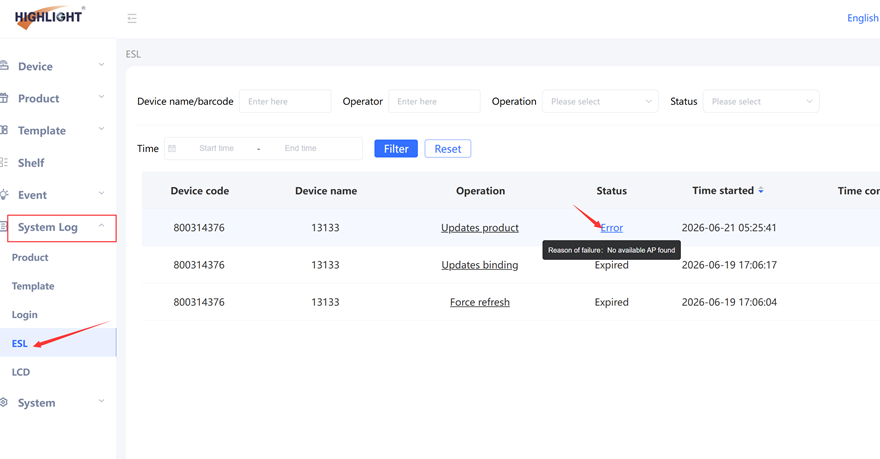
Every data push operation executed on MRB ESL hardware will leave traceable, permanent records stored in the built-in System Log module of our management dashboard. As shown in our system interface screenshot, the ESL log tab separately archives three core operation types: product information updates, device binding configuration and manual forced tag refresh commands. The platform marks each task with distinct status tags including Success, Error and Expired, while embedding specific failure prompts directly onto error entries. For instance, the error record labelled “No available AP found” intuitively tells technicians the root cause lies in disconnected access point equipment instead of software configuration errors. Beyond ESL transmission logs, the system also independently saves operation trails for product library edits, display template adjustments and administrator login behaviour, constructing a full audit trail for daily system maintenance and periodic safety inspections.
2. Real-Time Transmission Monitoring Backed by MRB Stable Wireless Infrastructure
High update failure rates mostly stem from unstable wireless communication between access points and digital shelf price tags, an issue MRB resolves with real-time signal monitoring. Our HA169 AP base station adopts anti-interference BLE 5.0 communication mode, delivering stable signal coverage inside supermarkets, pharmacies and convenience stores. The monitoring system continuously collects signal feedback during every data transmission process; once signal loss or AP disconnection occurs, the backend immediately flags the task as faulty and records the exact timestamp of the failed attempt. Compared with generic ESL products that only show vague “update failed” alerts without context, MRB links each transmission fault to corresponding AP operation data, greatly shortening troubleshooting cycles for on-site engineering personnel.
3. Fault Feedback Mechanism Reduces Retail Downtime & Labour Costs
Unresolved ESL update faults force retail staff to manually verify thousands of price tags across shelves, consuming massive working hours and increasing the risk of human-priced mismatches. MRB’s targeted fault feedback system eliminates this inefficient manual inspection work. System logs support multi-dimensional filtering via device barcode, operator account, operation type and custom time windows, allowing managers to batch export failed task data for unified maintenance arrangements. Expired tasks usually result from overtime transmission requests, while error codes correspond to AP offline, tag hardware failure or network congestion respectively. Store teams can prioritise repairing offline access points for bulk error records first, then replace faulty individual ESL units according to isolated error logs, forming a standardised, low-cost fault resolution workflow for long-term store management. Additionally, MRB ESL E-paper electronic price tags feature up to 5 years of standby battery life, lowering hardware replacement frequency and further stabilising overall system transmission performance.
4. Conclusion
Transmission monitoring and precise fault feedback are foundational pillars for maximising the practical value of electronic shelf label systems in physical retail. MRB does not only supply high-performance ESL hardware with stable wireless transmission performance, but also equips users with a fully featured log management system to visualise every data update process and quantify every system fault. From recording basic task status to marking concrete failure causes, our integrated monitoring tools reduce unplanned maintenance workload, guarantee on-shelf price accuracy and create higher overall ROI for global retail clients using MRB ESL E-ink digital price labeling solutions. When evaluating new ESL deployment or system upgrades, retailers should prioritise platforms with transparent fault feedback capabilities just as much as basic price update functionality.

Author: Lily Updated: July 23rd, 2026
Lily is a senior business development specialist at MRB with years of experience serving global retail clients with electronic shelf label solutions. She focuses on sharing practical technical knowledge, system operation guides and industry application insights for supermarket, pharmacy and retail chain operators adopting smart ESL technology. Her published articles aim to help overseas buyers fully understand MRB’s system functions and resolve common on-site deployment problems efficiently.
Post time: Jul-23-2026