
For public transit operators seeking seamless data interoperability between onboard passenger counting hardware and their central fleet management dashboards, compatibility and accessible communication protocols are non-negotiable requirements. Many automated passenger counter (APC) vendors lock operators into closed, proprietary software ecosystems with costly custom integration fees, creating operational bottlenecks when unifying ridership data with scheduling, GPS tracking, and passenger experience tools. MRB’s flagship HPC168 all-in-one 3D bus passenger counter stands apart by delivering fully free, unrestricted API and protocol access designed for straightforward transit platform integration, paired with industry-leading 3D stereo vision counting accuracy built specifically for rugged bus operating environments. This article breaks down the HPC168 automatic passenger counter’s open connectivity framework, its dual transmission protocols for online and offline bus networks, and the hardware advantages that make it a flexible fit for small municipal fleets and large urban transit authorities alike.
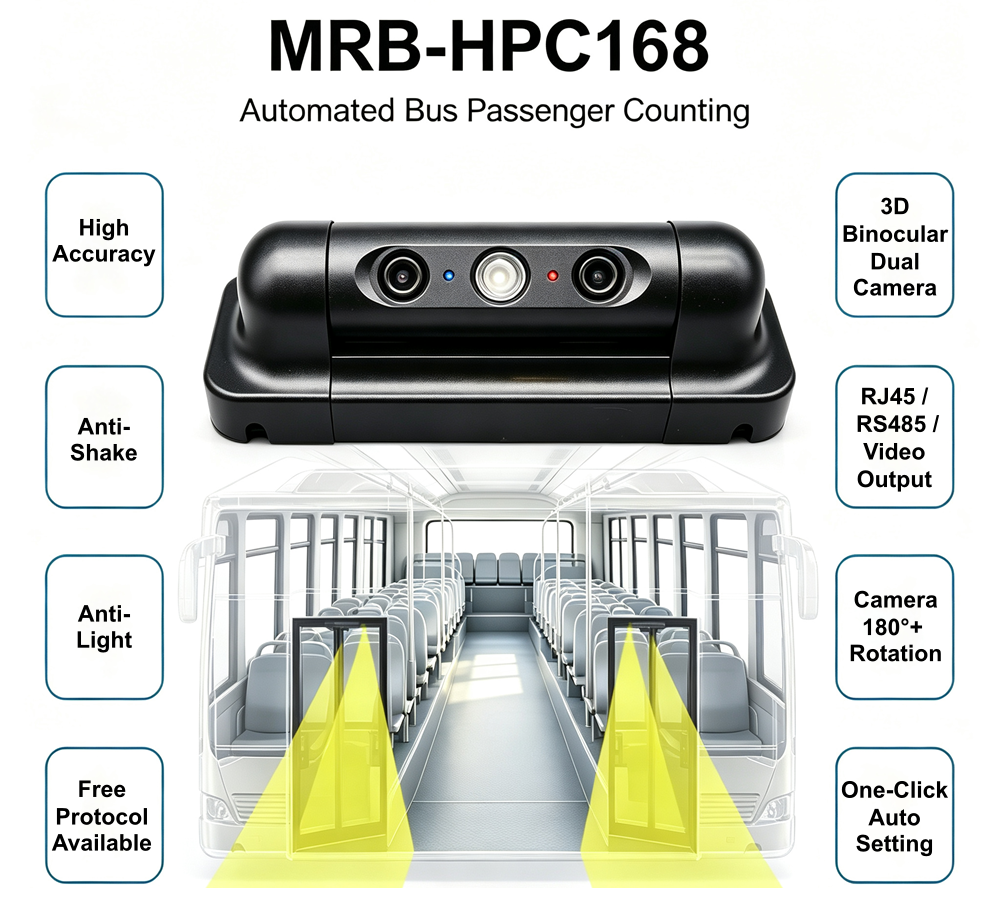
Table of Contents
1. HPC168 Core Hardware & 3D Counting Advantages Lay the Foundation for Reliable Data Output
2. Two Free Standard Protocols Support API Integration for Online & Offline Bus Network Scenarios
3. Free API Access Eliminates Integration Barriers for Transit Operators of All Sizes
1. HPC168 Core Hardware & 3D Counting Advantages Lay the Foundation for Reliable Data Output
Before exploring API integration, it is critical to understand the robust sensing hardware powering the HPC168 passenger counter sensor’s consistent, exportable passenger flow data. Unlike split camera-controller APC units that require complex wiring and extra maintenance, the MRB HPC168 is a compact all-in-one dual-camera 3D stereo counting device engineered for vehicle door installation. Its stereoscopic depth detection delivers a stable counting accuracy rate of 95%–98%, immune to harsh in-bus lighting fluctuations, strong shadows, and crowded overlapping passenger bodies during rush hours.
The HPC168 3D automatic passenger counting system features intelligent baggage filtering and adjustable target height restrictions to avoid miscounting luggage, strollers, or wheelchairs as passengers, while its one-click on-site calibration drastically cuts installation labor time for fleet technicians. Door trigger logic pauses or activates counting automatically based on door open/close signals, eliminating irrelevant data collection while buses are stationary at depots. All boarding and alighting metrics captured by the sensor feed directly into the unit’s open communication channels, with no proprietary data encryption blocking third-party platform access—this hardware reliability ensures the API transmits consistent, usable ridership data at all times.
2. Two Free Standard Protocols Support API Integration for Online & Offline Bus Network Scenarios
A core advantage of the MRB HPC168 automated 3D passenger counting camera’s free open API offering is its dual flexible transmission protocol setup, catering to buses with stable onboard internet and fleets operating in areas with spotty cellular coverage. Both protocols come with full, free technical documentation without hidden licensing charges, enabling transit IT teams to build native integrations with their existing management platforms without outsourcing expensive development work.
- RJ45 HTTP TCP Protocol for Connected Onboard Networks:
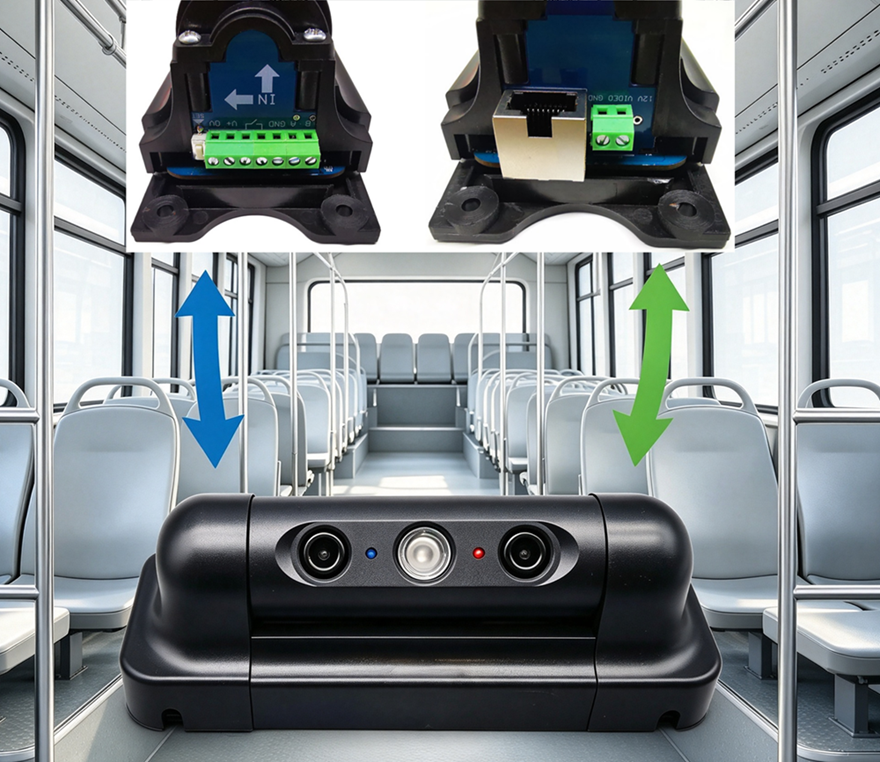
When buses maintain consistent Wi-Fi or 4G LTE connectivity, operators leverage the HPC168 passenger counter device’s RJ45 Ethernet port with an HTTP TCP-based open protocol. This real-time API pathway pushes continuous passenger inflow and outflow records directly to cloud transit management systems, supporting live occupancy monitoring, real-time route crowding alerts, and synchronized GPS stop-level ridership analytics. Transit platforms can pull streaming data feeds instantly to power passenger journey planning apps, dispatch control rooms, and automated scheduling modules.
- RS485 Polling Protocol for Offline/Weak-Coverage Operation:
For routes with unreliable cellular signals, the HPC168 electronic passenger head counter utilises its RS485 serial interface paired with a polling-style open protocol that works alongside GPRS vehicle communication hardware. Under this framework, the central transit server actively sends polling requests to retrieve cumulative passenger totals stored locally on the HPC168 passenger counting sensor. The device timestamps every data pull automatically; for example, a 10:00 server poll returns 10 boardings and 10 alightings, while a subsequent 10:05 poll logs an additional 15 entries and exits—platform backends simply calculate the 5-minute net passenger delta (5 boarding, 5 alighting) from two consecutive total datasets. The HPC168 bus passenger counter’s local storage supports cumulative passenger counts up to 999,999, ensuring no ridership data loss during extended offline periods until the server re-establishes polling access.
3. Free API Access Eliminates Integration Barriers for Transit Operators of All Sizes
Many competing APC manufacturers charge recurring fees or one-time custom development costs to unlock their system’s data interfaces, a financial burden that disproportionately impacts smaller municipal transit agencies with limited IT budgets. MRB’s HPC168 passenger counting sensors with camera removes this barrier entirely by providing unrestricted, royalty-free API and protocol documentation to every customer post-purchase. The open API structure supports seamless compatibility with custom-built transit management software, off-the-shelf fleet tracking platforms, and third-party MDVR recording systems, as the HPC168 passenger counter device can sync raw passenger footage to MRB vehicle mobile DVRs alongside numerical ridership datasets.
The multi-language firmware (English, Spanish, Chinese) also simplifies cross-regional integration, while the unit’s wide operating temperature range (-35℃ to 70℃) guarantees stable API data transmission in extreme summer and winter climates common to global transit networks. Operators can combine HPC168 passenger flow data with GPS bus stop location tracking to build granular demand forecasting tools, optimise route frequencies, and generate compliance-ready ridership audit reports—all through the free open API without vendor lock-in.
4. Conclusion
To directly answer the core question: Yes, the MRB HPC168 3D people counter for bus fully supports free, open API and protocol access for deep transit management platform integration, with two tailored communication pathways to match every fleet’s connectivity infrastructure. Its all-in-one 3D stereo hardware delivers highly accurate, filtered passenger flow data that feeds cleanly into the unrestricted HTTP TCP and RS485 protocols, eliminating costly proprietary integration restrictions seen across competing APC solutions. Whether managing a small local bus fleet with patchy cellular service or a large urban transit network with continuous onboard internet, the HPC168’s flexible open data architecture empowers IT teams to unify ridership analytics, GPS tracking, and vehicle video recording within a single centralised management platform. For transit operators prioritising long-term interoperability and scalable data-driven route optimisation, the HPC168 passenger counter for bus’s free open API framework makes it a high-value, future-proof passenger counting investment.

Author: Lily Updated: August 7th, 2026
Lily is a transit technology product specialist at MRB Retail with over 10 years of hands-on experience supporting public transit fleets with APC, mobile DVR, and vehicle surveillance hardware deployments across Europe, Southeast Asia, and North America, etc. She regularly creates educational technical content to help transit operators navigate sensor integration, protocol configuration, and fleet data analytics best practices, specialising in simplifying complex 3D passenger counting technology for non-specialist fleet management teams.
Post time: Aug-07-2026