
If you've ever watched an admin print twenty laminated cards at 8 a.m. for a day of back-to-back meetings, only to reprint half of them after a room change, you already know the paper name card carries a cost that never shows up on the stationery budget. Electronic table name cards have been on the market for a few years now, but most buyers still aren't sure whether the switch saves money or just adds another gadget to charge. We put the MRB HTC750 double-sided e-ink table card through that exact question — here's what the comparison looks like in real meeting rooms.
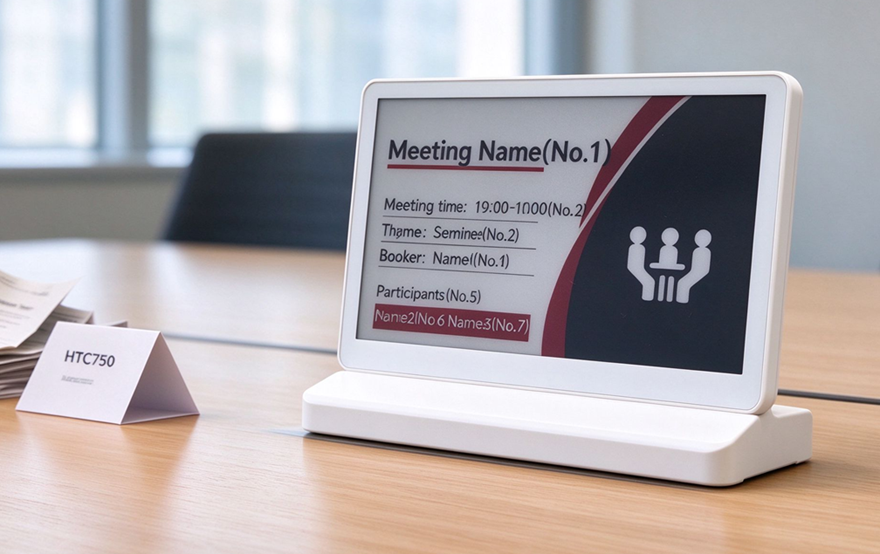
Table of Contents
1. The real cost of paper name cards isn't the paper
2. E-Ink changes the math because the screen only consumes power when it updates
3. Double-sided display is the feature people underestimate until they use it
4. Updating content wirelessly beats reprinting — once a day or a hundred times a day
5. Two AA batteries, no charging dock, no cable clutter
6. Conclusion: the break-even point depends on meeting volume, but the double-sided design tilts it
1. The real cost of paper name cards isn't the paper
A single printed card costs almost nothing. A hundred of them, rushed, misprinted, or thrown away after a single use, adds up fast — and that's before you count the laminator, the card holders, and the person spending an hour each morning setting tables. Paper cards are also rigid: once a meeting name, time slot, or attendee list changes, the card is wrong. In a corporate building running fifteen or twenty meetings a day across multiple floors, that waste is recurring, daily, and invisible until someone finally tallies it.
2. E-Ink changes the math because the screen only consumes power when it updates
Electronic paper displays don't light up like an LCD. They reflect ambient light, and they hold an image with zero power once the content is written. That means a conference electronic table sign can sit on a desk for months on two AA batteries instead of needing to be plugged in every night. It also means the card reads clearly under projectors, near windows, and in bright lobbies — places where glossy LCD table screens turn into unreadable mirrors.
3. Double-sided display is the feature people underestimate until they use it
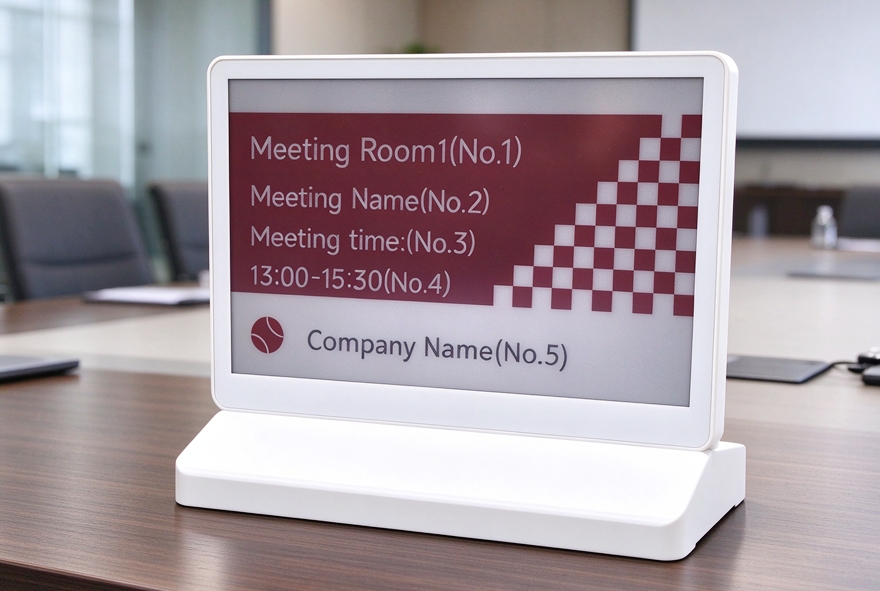
Most electronic name cards show content on only one side. On a conference table, that forces whoever sits across to look at a blank panel — or worse, staff have to remember which way each card faces. The MRB HTC750 E-paper digital name plate solves this with a true double-sided 7.5-inch display: both faces update in sync through the free Android app, so participants on either side of the table read the room name, meeting title, time slot, and host company in black, white, and red at 800×480 resolution. A red accent on the time slot or sponsor logo makes priority meetings stand out without extra design work.
4. Updating content wirelessly beats reprinting — once a day or a hundred times a day
The HTC750 electronic table name card pairs over Bluetooth 4.0 and supports NFC tap-to-write, so a planner can push a new agenda to every card in a room from their phone in seconds. Forget a meeting name at the front desk? Tap the card, type, done. For events running parallel sessions, this is where the device pays for itself: instead of a runner re-laminating signs between breaks. The app handles templates, room schedules, and company branding.
5. Two AA batteries, no charging dock, no cable clutter
Unlike LCD conference displays that need a proprietary dock and a power outlet at every seat, the HTC750 double-sided e-ink meeting sign runs on two standard AA batteries — the kind you can buy at any convenience store. At 214 grams and a footprint of 171×70×141 mm, it sits stable on a desk without sliding, and the matte white (or optional gold) housing blends into most boardrooms instead of looking like a consumer gadget. Operating temperature is rated 0 °C to 40 °C, which covers nearly every indoor meeting space.
6. Conclusion: the break-even point depends on meeting volume, but the double-sided design tilts it
A single conference room using paper cards once a week may not need an electronic name card. But once your building runs rotating meeting rooms, half-day seminars, or daily multi-room schedules, the MRB HTC750 7.5 inch Bluetooth NFC dual‑screen electronic table sign pays for itself through labor saved, reprints avoided, and the professional impression a synchronized, red-accented e-ink sign leaves on visitors. The double-sided display is the detail that separates it from cheaper single-screen alternatives — because no one wants to explain why the other side of the table is blank.

Author: Lily Updated: October 16th, 2026
Lily is a B2B product writer at MRB Retail, covering electronic shelf labels, e-ink conference solutions, and retail digital signage. She focuses on the hardware and integration details that actually matter to procurement teams — battery life, update latency, and total cost of ownership — rather than marketing claims. Have a question about the HTC750 for your conference rollout? Reach out to the MRB team for specs, samples, and bulk pricing.
Post time: Oct-16-2026